When print shops look at steel rule die cost, the first number they usually see is the price of the die itself. But that’s only part of the picture. The real cost of die-cutting a job also includes a lot of things, including the setup, storage, lead times, minimum quantities, outsourcing, and the amount of time your team spends getting the job through production. In this article, we will examine not only the costs associated with steel rule dies but also an alternative solution, like FINISHpro, that can significantly reduce production time and improve overall process efficiency.
What goes into steel rule die cost?
A steel rule die is a physical cutting tool made with steel blades formed into the exact shape needed for a job. Once mounted in a die-cutting press, it can be used to produce that shape repeatedly.
However, the tooling price is only one part of the calculation. Depending on the job, you may also need to account for:
Die Creation
A custom shape requires a steel rule die to be designed and manufactured specifically for that cutting pattern. The more specialized the shape or requirements, the more important it is to consider this upfront tooling expense, including any custom die charge.
Setup
The die needs to be installed and the press prepared before production can begin. Setup takes time, and that time becomes part of the overall production cost, particularly when you're running smaller quantities.
Minimum Quantities
A physical die has an upfront cost regardless of whether you're producing 100 pieces or 10,000. For smaller orders, there are fewer pieces across which to spread that initial investment, which can make the job more expensive per piece.
Storage
If the same job is expected to return, the die needs to be stored properly and kept organized so it can be located and used again. While this may seem minor for one job, managing physical tooling becomes another consideration when you have many custom dies.
Changes
Physical tooling is made for a specific cutting pattern. If the customer changes the shape significantly or requests a different version, the existing die may no longer be suitable. That could mean additional tooling and another expense
Outsourcing
If you don't have die-cutting capabilities in-house, you may need to send the job to another provider. In addition to the cutting service itself, you may also have to factor in shipping, coordination, and the extra time required to complete the order.
Labour: Die cutting involves more than running the press. Your team may spend time preparing materials, setting up the job, handling sheets, checking the finished pieces, and completing any necessary finishing or cleanup. That labour contributes to the true cost of the job.
When you add these factors together, you get a more realistic picture of what you're actually spending to produce a die-cut job. The die cutting die cost may be the most visible expense, but it's the total production cost that ultimately affects your margins.
When does a steel rule die make sense?
A steel rule die can be an efficient choice when you're producing a consistent design in larger quantities. Because the same physical die can be used repeatedly, the initial tooling investment becomes easier to justify as production volume increases.
If a customer orders 10,000 pieces of the same packaging design and expects to reorder regularly, the cost of the die can be distributed across a large number of finished pieces. The tooling continues to provide value each time that job goes back into production.
But the calculation can look very different for a smaller order.
If a customer only needs 100 custom-shaped pieces for an event, product launch, or promotional campaign, the cost of creating the die makes up a much larger portion of the job. And if they later request a different shape or design, the existing die may no longer work for the new version.
This is why we recommend looking at quantity, how often the job will be repeated, and how likely the design is to change when deciding whether traditional die cutting is the right fit.
A production method that works well for large, repeat orders may not be as practical for smaller jobs with changing requirements.
Digital die cutting changes the equation
A digital die cutter doesn't require a traditional physical die for every shape. The cutting path is controlled digitally, which makes it easier to move from one design to another without creating new tooling.
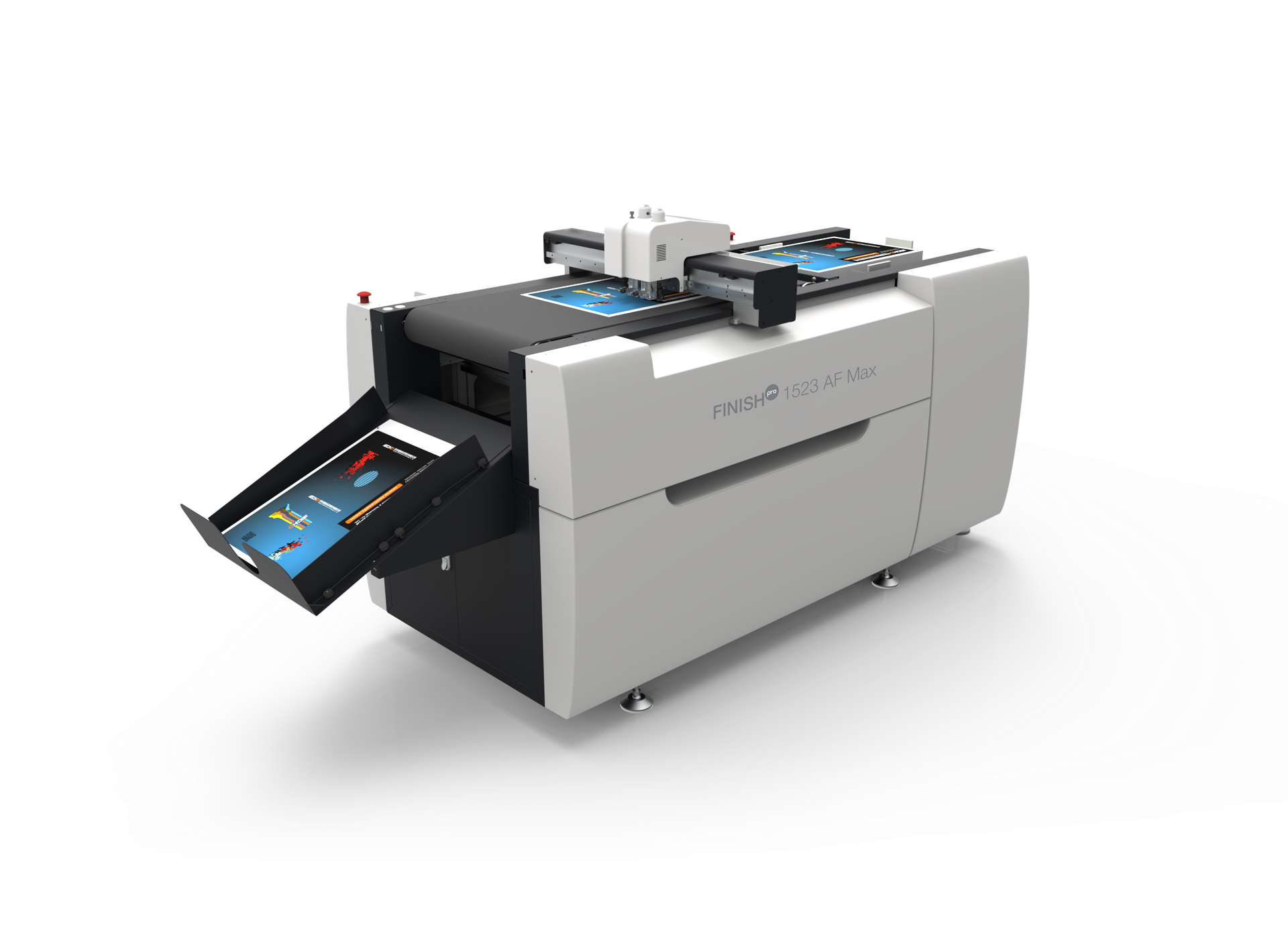
FINISHpro 1523 AF Max
Take the FINISHpro 1523 AF Max for example. It gives print shops another way to handle custom-shaped jobs without having to create a physical die for each new design. Whether it's a small batch of cards, a custom label, a packaging piece, or another specialty project, the same machine can be used for different shapes and jobs.
That can be particularly useful when you're dealing with:
- Short production runs
- Multiple versions of the same design
- Personalized or variable-shaped products
- Prototypes and samples
- Last-minute customer requests
- Jobs that would otherwise be outsourced
The point isn't that digital cutting is automatically cheaper for every job. It's that the cost structure is different
Steel rule die vs. digital die cutter
This is where the numbers become more useful.
Suppose you're comparing two ways to produce a custom job. One requires a physical die, while the other can be produced digitally.
Rather than comparing only the tooling price, look at the full production cost.
Cost consideration | Steel rule die | Digital die cutter |
Initial tooling | Physical die required | No traditional die required |
New shape | May require new tooling | New digital cutting file |
Short runs | Tooling can represent a larger share of cost | Often well suited |
Design changes | May require additional tooling | Easier to accommodate |
Outsourcing | May add production and shipping costs | Can be produced in-house if equipment is available |
Repeat production | Well suited to consistent repeat work | Also suitable depending on application |
This doesn't mean digital cutting replaces traditional die cutting. For some, the two can still complement each other. It's about matching the process to the job.
Look at what you're outsourcing
If you're trying to determine whether investing in digital cutting makes sense, your existing production history is a good place to start.
Take a look at the custom-cut jobs you've outsourced over the past few months and ask yourself:
- How many jobs required custom cutting?
- How much did outsourcing cost?
- How much time did outsourcing add?
- How often did customers request changes?
- How much work could realistically be brought in-house?
Looking at real jobs gives you a better basis for making an equipment decision than simply comparing machine prices.
Don't forget the value of turnaround time
Cost per job isn't always measured in dollars. Time affects the value of a job, too.
When cutting is outsourced, you're working around another provider's schedule. That can mean extra coordination, shipping, and waiting before the finished pieces return to your shop.
For time-sensitive orders, those extra steps can add friction to the workflow. Bringing digital dcutting in-house can give you greater control over production and help you respond more quickly when deadlines are tight or changes come up.
Choosing the right digital die cutter
Once you've established that digital cutting could be useful, the next step is choosing a system that matches your applications.
The right equipment should support the kind of work you want to make profitable. Before investing, consider how the cutter will fit into your day-to-day production and whether it can handle the demands of the jobs you expect to run.
A smaller shop producing cards, labels, invitations, and similar printed products may have very different requirements from a business producing packaging prototypes, signage, magnetic graphics, or thicker substrates.
That's why we don't take a one-size-fits-all approach at Skandacor.
Our FINISHpro range includes different sizes and configurations, allowing print shops to consider factors such as sheet size, material thickness, applications, and production requirements when choosing a system.
The best investment isn't necessarily the machine with the most features. It's the one that earns its place on your production floor.
Our Digital Die-Cutters
Check out our digital Die cutters!
The bottom line
The cheapest way to produce a job isn't always the way to produce the most profitable job.
A production method should earn its place by making sense for the work, the customer, and your business. Sometimes that means sticking with a proven steel rule die. Other times, it means having a different way to handle the jobs that don't fit that model.
At Skandacor, that's how we approach digital finishing. We don't believe in changing your process just for the sake of new equipment. We believe in giving print shops the tools to make better production decisions—and the ability to say yes to work that makes business sense.
If you're evaluating where digital cutting could fit into your shop, let's talk about your production goals. We help print businesses across Canada, USA, Europe, and beyond determine whether a FINISHpro system is the right move for their business.