Starting a die-cut sticker business does not necessarily require a large production setup from day one. What matters is understanding your market, choosing equipment that fits your needs, and building a workflow that can handle the orders you expect to receive. Die-cut stickers are cut to follow the exact shape of a design rather than a standard square or rectangle. The cutting path follows the artwork’s outline, creating a finished sticker in its intended shape.
For businesses, stickers can reinforce a brand, add a finishing touch to packaging, or serve as a simple promotional tool. For artists and creators, they can turn original designs into products that customers can take home.
This guide covers the main decisions involved, from choosing your market and equipment to making stickers, setting prices, finding customers, and protecting your business from common risks.
Decide what kind of sticker business you want to build
Before investing in equipment, think about who you want to sell to. Your target market will influence the materials you use, the designs you produce, order sizes, and the equipment you need.
You could focus on custom stickers for small businesses, branded packaging, events, artists, schools, or personal projects. Another option is selling your own designs online or providing wholesale sticker production for businesses that need larger quantities.
Start by identifying a specific need you can serve well. A bakery, for example, may need logo stickers for packaging, while an artist may need small batches in several shapes. Defining your market early can help you develop a focused product offering and avoid investing in capabilities you don't yet need.
Estimate your expected production volume
Before choosing equipment, consider the type and quantity of orders you expect to produce. A business selling small batches of its own designs has different production requirements from a print shop producing hundreds of custom sticker sheets each day.
Think about your typical order quantities, sheet sizes, number of designs per job, and how frequently jobs will change. This can help you determine whether an entry-level cutter is enough or whether a more automated production system would provide a better long-term workflow.
Choose the right sticker business equipment
The right equipment depends on your expected production volume, the materials you plan to use, and the types of stickers you want to offer.
For smaller operations, a sticker maker machine or entry-level cutter may be enough to get started. If you expect to handle larger orders, frequent job changes, or more complex designs, a production-oriented digital die cutter can provide greater flexibility.
When evaluating equipment, consider more than cutting speed. Look at the feeding method, material compatibility, maximum sheet size, and whether the machine can handle additional finishing processes. It’s also worth considering how easily you can switch between different jobs.
How to make die-cut stickers?
If you're learning how to make die-cut stickers, the process starts with preparing the artwork. The design should have the correct dimensions, bleed, and cutting outline before it is printed onto the chosen sticker material.
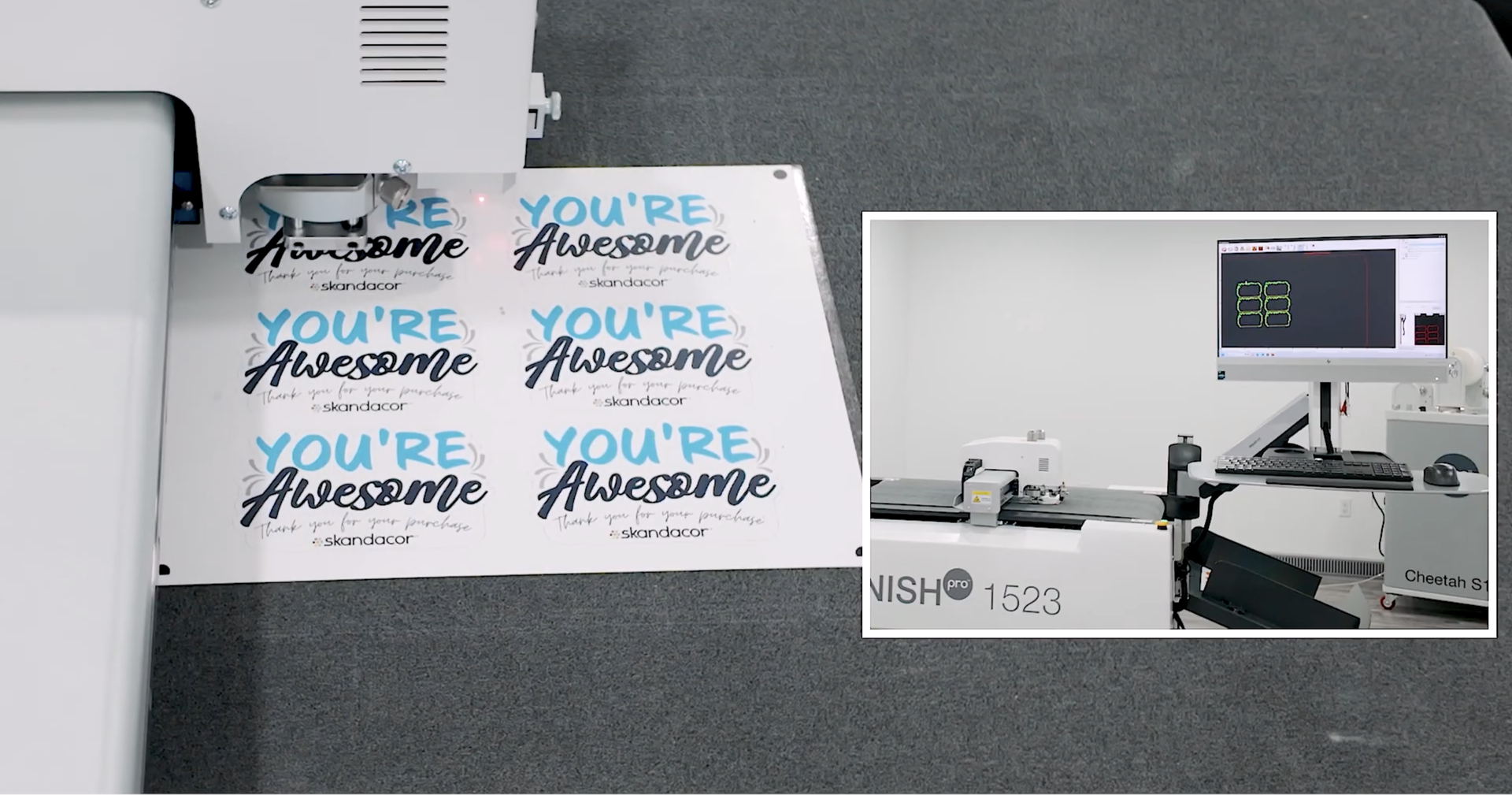
After printing, the sheet moves to the finishing stage, where the cutting equipment follows the digital outline around each design. Depending on the application, you may use coated paper label stock, synthetic media, pressure-sensitive vinyl, or another specialty substrate.
Before producing a large order, test the complete process using the actual material you plan to sell. Check print quality, registration, cut accuracy, peeling, and overall appearance. Testing beforehand can help catch problems before they affect a full batch.
Kiss cut vs. die-cut stickers
The main difference between kiss-cut and die-cut stickers is how deeply the material is cut.
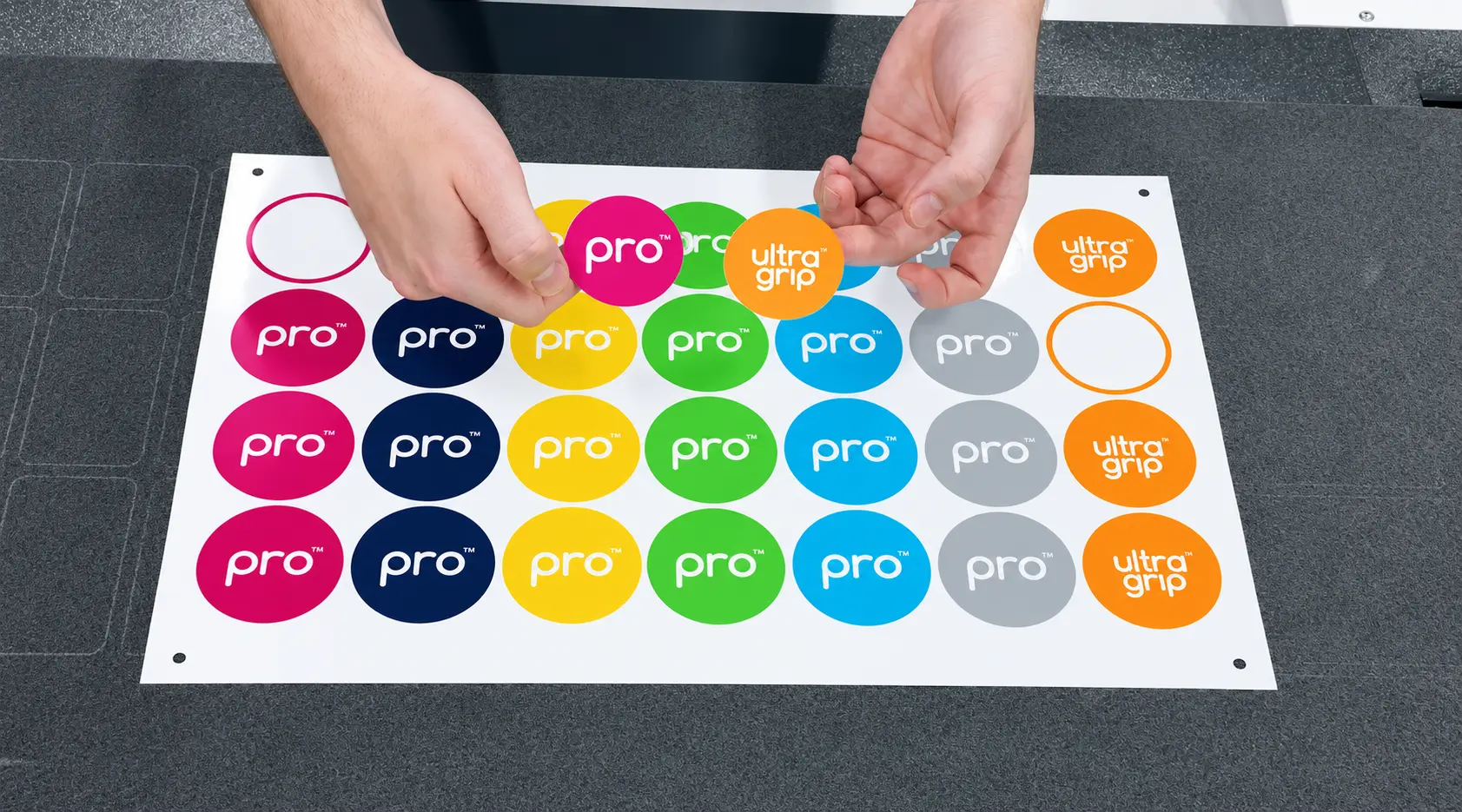
Kiss-cut stickers
A kiss cut cuts through the sticker material while leaving the backing sheet intact. This allows individual stickers to be peeled from a larger sheet or backing.
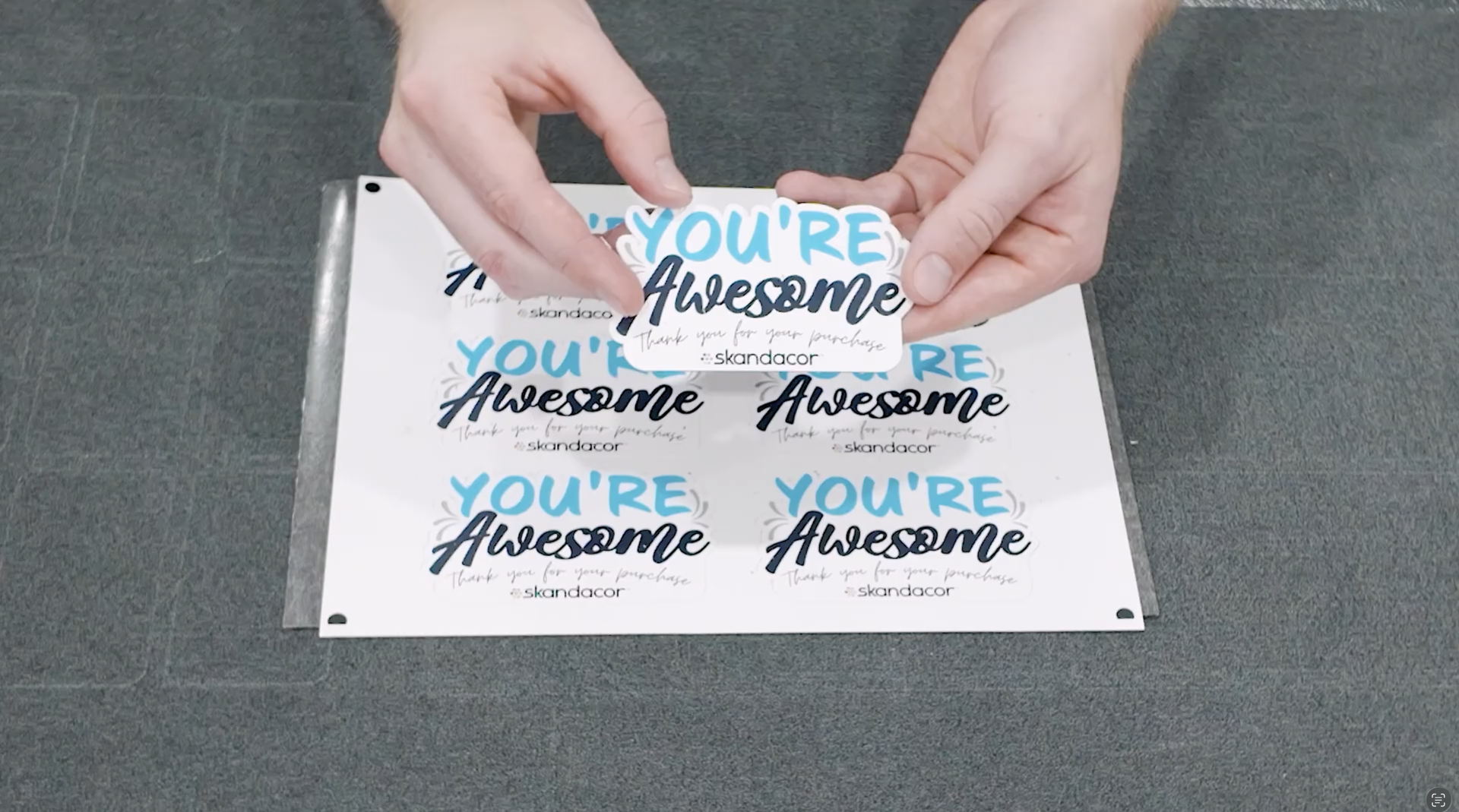
Die-cut stickers
Die-cut stickers are stickers cut all the way through the sticker and backing material, following the exact outline of the design. This gives each sticker its own custom shape and allows it to be peeled off individually.
Plan your production workflow
A sticker business involves more than printing and cutting. A basic workflow might look like this:

As order volume increases, look for steps that create unnecessary handling or bottlenecks. Automated feeding, batching similar jobs, and organizing production by substrate or finish can reduce setup time and help operators keep work moving.
Keeping these steps organized becomes increasingly important as order volume increases. Batching similar materials and designs can reduce setup time and make production more efficient.
Quality control is just as important. Check that the artwork is printed correctly, the cut follows the intended outline, and the finished stickers have clean edges. If you offer laminated products, inspect the surface for bubbles, lifting, or other defects before packaging.
Sell locally and online
A die-cut sticker business can reach customers through several channels. Local businesses can be a strong starting point because you can show physical samples and build relationships directly. Packaging stickers, logo stickers, promotional stickers, and event materials can also create opportunities for repeat orders.
Online sales can expand your reach beyond your local market. Make the ordering process clear by explaining sizes, materials, finishes, turnaround times, and file requirements.
If you plan to sell internationally, factor in shipping costs, delivery times, taxes, customs fees, and any local requirements before accepting orders. Be sure to include these expenses in your pricing so international sales remain profitable.
Protect your business
Custom sticker production can involve artwork supplied by customers, so be careful about copyrighted logos, characters, artwork, and other protected designs. Make sure you have permission to reproduce designs when required.
It also helps to have clear policies for artwork approval, revisions, production times, returns, and damaged shipments. A written approval process can prevent misunderstandings about the final product.
Choosing a digital die cutter for sticker production
If you're looking for equipment that can grow with your sticker business, the FINISHpro 1523 AF is one option to consider. Its 15" × 23" cutting area and die-free digital workflow are suited for applications such as adhesive sheets, labels, tags, and other standard print materials. It can process sticker stock along with substrates up to 1.8 mm thick, giving shops the flexibility to produce stickers while also taking on a wider range of everyday finishing applications.
For shops looking to work with a broader range of substrates, the FINISHpro 1523 AF Max offers additional material flexibility. It has the same 15" × 23" cutting area but can process materials up to 6 mm thick, including sticker stock and magnetic sticker stock. Its additional tooling also allows shops to take on applications beyond stickers, including specialty cards, magnetic graphics, packaging, and other custom projects.
FINISHpro AF
- Cutting area: 15" × 23"
- Workflow: Die-free digital cutting
- Substrate thickness: Up to 1.8 mm
- Applications: Stickers, labels, tags, and other print materials
FINISHpro AF Max
- Cutting area: 15" × 23"
- Thickness: Up to 6 mm
- Materials: Stickers, magnets, and specialty substrates
- Applications: Cards, packaging, and custom projects
The right choice depends on the work you plan to produce. The FINISHpro 1523 AF may be a practical fit for shops focused primarily on stickers, labels, and other standard print materials, while the FINISHpro 1523 AF Max offers more options for shops working with thicker or more varied substrates.
Keep in mind that a digital die cutter handles the cutting stage of production. You will still need a suitable printing process—or access to printed sheets—to produce the artwork before cutting.
Build with room to grow
A good sticker business starts with a clear idea of what you want to offer, but it doesn’t have to stay limited to that first idea. As you learn more about your customers, you may find opportunities to introduce new products or finishing applications.
The important thing is to build your operation around real demand. Let the work you’re getting—and the work you want to pursue—guide your next investment rather than adding equipment simply for the sake of expanding.
Skandacor serves print shops and customers in Canada, USA, and Europe, to build finishing workflows around the applications they want to produce.
Ready to explore what you can produce? Discover our FINISHpro digital die cutters and compare finishing solutions for stickers, labels, packaging, and other custom applications.